UCC researchers have discovered a renowned fossil found in 1931 is a forgery

All is not as it seems.
A team of researchers at University College Cork have discovered that a renowned reptile fossil thought to show soft tissue preservation is, in fact, just paint.
The 280-million-year-old fossil, known as Tridentinosaurus Antiquus, was discovered in the Italian Alps in 1931 and was thought to be an important specimen for understanding early reptile evolution. Its body outline, appearing dark against the surrounding rock, was initially interpreted as preserved soft tissues. This led to its classification as a member of the reptile group Protorosauria.
The purported fossilised skin had been celebrated in articles and books but never studied in detail. It has baffled researchers for decades but has now been shown to be, in part, a forgery following a new examination of the remnants.
‘The answer to all our questions was right in front of us’
The team, led by UCC’s Dr Valentina Rossi, has now cautioned other researchers about how the fossil is used in future research.
A report published today in the scientific journal Palaeontology reveals that the fossil renowned for its remarkable preservation is mostly just black paint on a carved lizard-shaped rock surface.
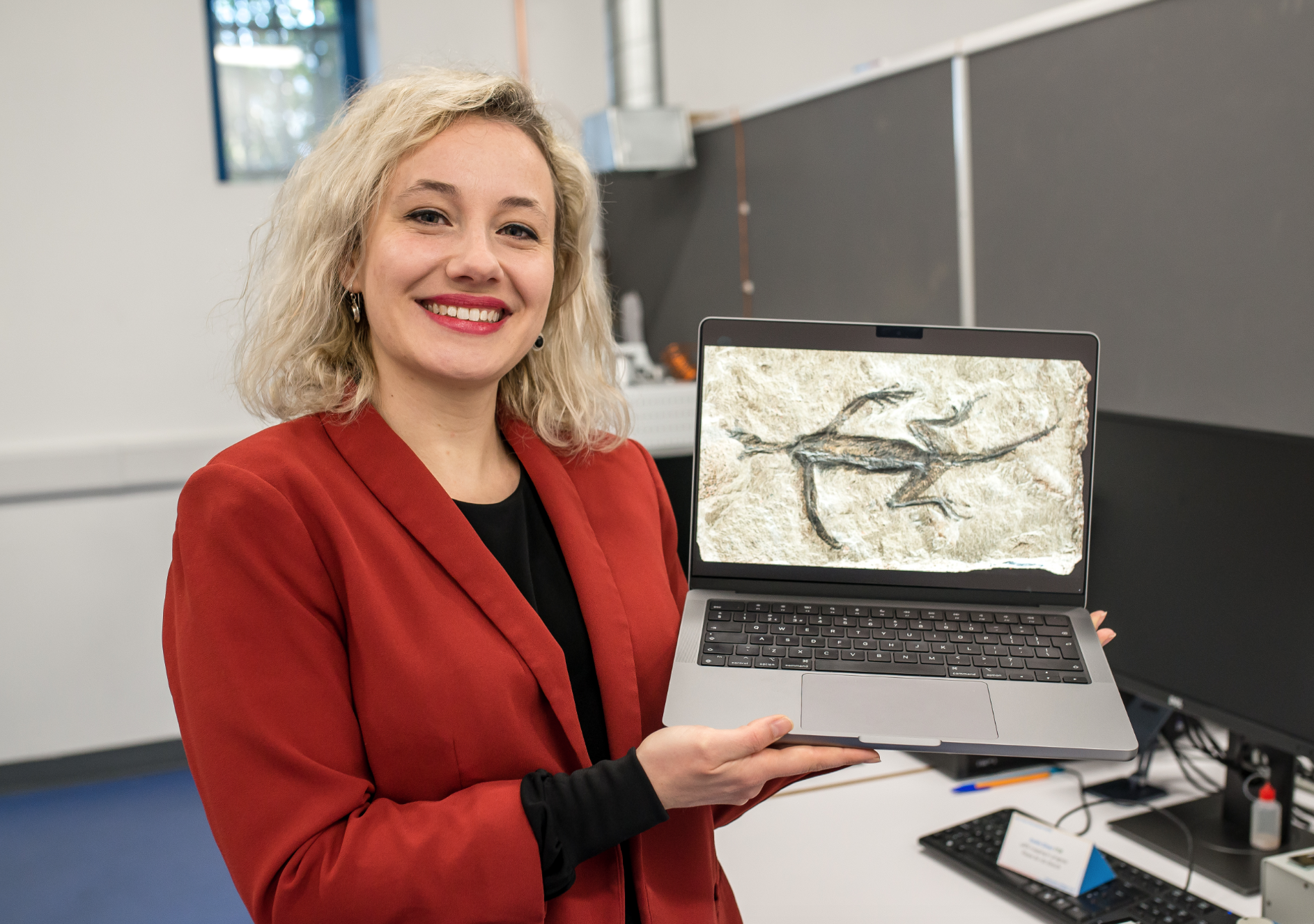
Dr Valentina Rossi of University College Cork.
“Fossil soft tissues are rare, but when found in a fossil they can reveal important biological information, for instance, the external colouration, internal anatomy, and physiology.” said Dr Rossi.
“The answer to all our questions was right in front of us, we had to study this fossil specimen in detail to reveal its secrets – even those that perhaps we did not want to know.”
The microscopic analysis showed that the texture and composition of the material did not match that of genuine fossilised soft tissues.
Preliminary investigation using UV photography revealed that the entirety of the specimen was treated with some sort of coating material, a process that was the norm in the past and sometimes is still necessary to preserve a fossil specimen in museum cabinets and exhibits. The team was hoping that beneath the coating layer, the original soft tissues were still in good condition to extract meaningful palaeobiological information.
Unfortunately, the findings indicate that the body outline of Tridentinosaurus Antiquus was artificially created, likely to enhance the appearance of the fossil.
However all not all is lost, and the fossil is not a complete fake.
The bones of the hindlimbs, in particular, the femurs seem genuine, although poorly preserved. Moreover, the new analyses have shown the presence of tiny bony scales called osteoderms – like the scales of crocodiles – on what perhaps was the back of the animal.